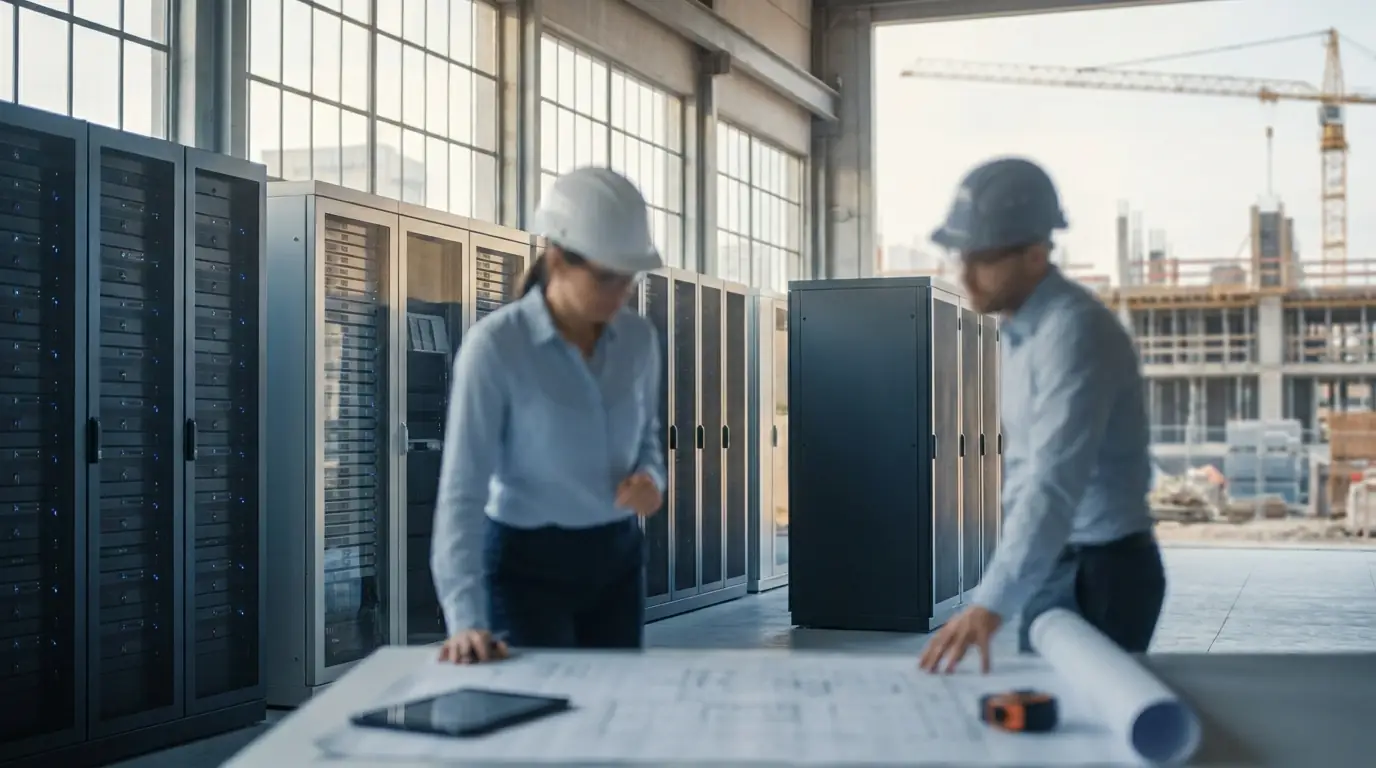
The digital economy is accelerating at an unprecedented pace, fueled by AI, IoT, and the ever-expanding cloud. This growth translates directly into an insatiable demand for robust, high-performance data infrastructure. For developers and investors eyeing this lucrative sector, a meticulously executed data center feasibility study is not just a recommendation; it's an absolute necessity. It serves as the foundational blueprint, rigorously evaluating the technical, financial, and market viability of a proposed project before significant capital is committed.
This guide, crafted by the SimpleFeasibility Editorial Team with backgrounds in corporate finance, venture investment, and small business advisory, provides a comprehensive, authoritative framework for conducting a data center feasibility study in 2026. We'll delve into the specifics, from power and cooling to CAPEX/OPEX projections, revenue models, and critical risks, equipping you with the insights lenders and investors demand.
Understanding the Data Center Landscape
The global data center market continues its rapid expansion, driven by enterprises migrating to cloud services, the explosion of data from edge computing, and the intensive processing demands of artificial intelligence. Understanding the prevailing market models is crucial for tailoring your feasibility analysis:
- Hyperscale Data Centers: Massive facilities, often exceeding 50MW, built and operated by tech giants (e.g., AWS, Google, Microsoft) for their own cloud services. These typically demand vast land, power, and fiber resources, with a focus on extreme efficiency and scale.
- Colocation Data Centers: Facilities that lease space, power, and cooling to multiple tenants. These range from small cage deployments to multi-megawatt wholesale suites. The revenue model here is diverse, catering to enterprises, service providers, and even smaller hyperscalers. A robust colocation feasibility study requires detailed market analysis of local demand and competitive pricing.
- Enterprise Data Centers: Facilities owned and operated by a single company for its internal IT needs. While still prevalent, many enterprises are migrating to cloud or colocation solutions to reduce capital expenditure and operational burden.
Your strategic choice between these models will profoundly influence site selection, design, financial projections, and risk profile. The market continues to evolve, making a detailed data centre feasibility study essential for navigating its complexities.
Critical Components of a Data Center Feasibility Study
Power and Cooling Requirements
Power and cooling are the lifeblood of any data center, often representing the largest components of both CAPEX and OPEX. Precise calculations are non-negotiable.
- IT Load Density: This refers to the power consumed per rack, typically ranging from 5kW/rack for general enterprise to 20-30kW/rack for high-performance computing (HPC) or AI workloads. Some specialized racks can exceed 50kW.
- Total IT Load (MW): The aggregate power demand of all IT equipment. This is the primary driver for facility sizing. For example, a 10MW IT load facility is a common mid-to-large scale project.
- Power Usage Effectiveness (PUE): A critical metric, PUE measures the ratio of total facility power to IT equipment power. A PUE of 1.0 means all power goes to IT; a PUE of 2.0 means for every watt used by IT, another watt is used by cooling, lighting, etc. Modern, efficient data centers target PUEs between 1.2 and 1.4. Achieving a low PUE directly reduces operational costs.
- Cooling Technologies:
- Air Cooling (CRAC/CRAH): Traditional method, effective for lower densities.
- Liquid Cooling (Direct-to-Chip, Immersion): Becoming more prevalent for high-density racks and AI workloads due to superior efficiency.
- Evaporative/Adiabatic Cooling: Utilizes water evaporation for cooling, highly efficient in drier climates, but requires significant water access.
- Free Cooling: Using outside air when temperatures are low enough, reducing mechanical cooling needs.
- Redundancy Levels: Designing for uptime is paramount.
- N: No redundancy.
- N+1: One redundant component for each critical system (e.g., N active + 1 standby UPS).
- 2N: Fully redundant systems (two independent systems, each capable of handling the full load).
- 2N+1: Even higher redundancy.
Higher redundancy levels significantly increase CAPEX but mitigate risk, a trade-off carefully evaluated in the data center feasibility process.
Site Selection and Grid Interconnection
The chosen location dictates much of a data center's long-term success and operational viability.
- Power Availability and Cost: Paramount. Proximity to reliable, high-capacity substations is key. Evaluate the cost per kWh, which varies significantly by region.
- Fiber Connectivity: Multiple, diverse fiber routes are essential for low latency and high bandwidth. Proximity to major internet exchange points is a significant advantage.
- Latency: Critical for many applications. Consider proximity to target end-users or major peering points.
- Natural Disaster Risk: Assess susceptibility to floods, earthquakes, hurricanes, and other natural events.
- Land Cost and Availability: Large parcels are often required, especially for hyperscale developments.
- Water Access: Essential for many cooling systems, especially evaporative or adiabatic. Evaluate water availability, cost, and discharge regulations.
- Regulatory Environment: Permitting processes, environmental regulations, tax incentives, and local zoning laws can vary widely and impact project timelines and costs.
- Skilled Labor Pool: Availability of qualified technicians, engineers, and security personnel.
Grid interconnection involves securing the necessary power capacity from the utility, which can be a lengthy and costly process, often involving new substations or transmission lines. This must be factored into the project timeline and budget.
Capital Expenditure (CAPEX) Projections
Data centers are inherently capital-intensive. Accurate CAPEX forecasting is critical for securing funding. Below are estimated ranges for a greenfield data center development (excluding IT equipment, which tenants typically provide) per MW of IT capacity in 2026 dollars. These figures can fluctuate significantly based on location, redundancy, design choices, and scale.
| CAPEX Component | Estimated Cost Range per MW (2026 USD) |
|---|---|
| Land Acquisition & Site Prep | $500,000 - $1,500,000 |
| Building Shell & Core | $1,500,000 - $3,000,000 |
| Power Infrastructure (Generators, UPS, Switchgear, Transformers) | $4,000,000 - $7,000,000 |
| Cooling Infrastructure (Chillers, CRACs, Cooling Towers, Piping) | $1,500,000 - $3,000,000 |
| Network Infrastructure (Fiber build-out, dark fiber leases) | $300,000 - $800,000 |
| Security Systems (Fencing, Cameras, Access Control) | $200,000 - $500,000 |
| Fire Suppression | $100,000 - $300,000 |
| Fit-out (Racks, Cabling, Lighting, Raised Floor) | $500,000 - $1,000,000 |
| Soft Costs (Design, Engineering, Legal, Permitting) | $800,000 - $1,500,000 |
| Contingency (10-15%) | $1,000,000 - $2,500,000 |
| Total Estimated CAPEX per MW | $10,400,000 - $21,100,000 |
Note: These are illustrative estimates for a new build. Refurbishment or expansion of existing facilities may have different cost structures.
Operational Expenditure (OPEX) Analysis
OPEX determines the long-term profitability of a data center. It's crucial to forecast these costs accurately, as they are recurring and significant.
| OPEX Component | Estimated Annual Cost Range per MW (2026 USD) |
|---|---|
| Power Costs (Electricity) | $800,000 - $1,500,000 (Highly variable by region and PUE) |
| Staffing (Operations, Security, Maintenance) | $300,000 - $600,000 |
| Maintenance & Repairs (HVAC, Electrical, Generators) | $200,000 - $400,000 |
| Network Connectivity (Fiber Leases, Bandwidth) | $100,000 - $300,000 |
| Property Taxes & Insurance | $150,000 - $350,000 |
| Water Usage (for cooling) | $20,000 - $100,000 (Highly variable by cooling method and climate) |
| Software Licenses & IT Tools | $50,000 - $150,000 |
| Security Services (Contracted) | $50,000 - $150,000 |
| General & Administrative | $100,000 - $200,000 |
| Total Estimated OPEX per MW per Year | $1,770,000 - $3,700,000 |
Note: Power costs are a major variable, assuming an average electricity price of $0.08 - $0.15 per kWh and a PUE of 1.3. Higher PUE or electricity prices will increase this significantly.
Revenue Models and Market Strategy
Defining your revenue model and understanding market demand is paramount for a viable data center business plan.
Colocation vs. Hyperscale
- Colocation: Revenue is typically generated by leasing physical space (rack units, cages, private suites) and associated power. Pricing models include:
- Per Rack Unit (RU): Common for smaller tenants.
- Per kW: Charging for allocated power capacity.
- Per kWh: Charging for actual power consumption.
- Fixed Monthly Fee: For private cages or suites, often including a power allotment.
- Cross-Connects: Fees for connecting to other tenants or carriers within the facility.
- Hyperscale/Wholesale: Revenue comes from leasing large blocks of space and power (e.g., 1MW, 5MW, or entire buildings) to a single tenant, often on long-term contracts (5-15 years). Pricing is typically negotiated per MW per month.
Market rates vary significantly by region, competition, facility tier, and power density. Comprehensive market research, including competitive analysis and demand forecasting, is crucial for setting appropriate pricing.
Utilization and Ramp-Up
Data centers have high fixed costs, making utilization a key driver of profitability. A phased build-out strategy, where capacity is brought online in stages (e.g., 2MW increments for a 10MW facility), can mitigate risk and align CAPEX with demand. However, it also means initial phases may have higher per-MW costs.
A realistic ramp-up schedule, projecting how quickly capacity will be sold and activated, is vital for financial modeling. Factors influencing ramp-up include:
- Market demand and competitive landscape.
- Effectiveness of sales and marketing efforts.
- Ability to secure anchor tenants before or during construction.
- Time required for tenant fit-out and equipment deployment.
Financial Projections and Investment Metrics
A robust financial model is the heart of any data center feasibility study, allowing investors to assess profitability and risk.
Worked Example: NPV, IRR, Payback Period
Let's consider a simplified example for a 10MW colocation data center project over 15 years.
Assumptions:
- Total CAPEX: $150,000,000 (avg. $15M/MW)
- Annual OPEX: $25,000,000 (avg. $2.5M/MW)
- Revenue per MW: $4,000,000 per year (avg. $333,333/MW/month)
- Ramp-up Schedule:
- Year 1: 20% utilization (2MW)
- Year 2: 40% utilization (4MW)
- Year 3: 60% utilization (6MW)
- Year 4: 80% utilization (8MW)
- Year 5 onwards: 90% utilization (9MW) - assuming 10% always reserved/available for churn/growth
- Discount Rate (WACC): 10%
- Terminal Value: Assumed 10x Year 15 EBITDA for simplicity.
Simplified Annual Cash Flow Calculation (Illustrative):
| Year | CAPEX | Revenue | OPEX | Net Cash Flow (before Terminal Value) | Discount Factor (10%) | Discounted Cash Flow |
|---|---|---|---|---|---|---|
| 0 | ($150,000,000) | $0 | $0 | ($150,000,000) | 1.000 | ($150,000,000) |
| 1 | $0 | $8,000,000 | ($25,000,000) | ($17,000,000) | 0.909 | ($15,453,000) |
| 2 | $0 | $16,000,000 | ($25,000,000) | ($9,000,000) | 0.826 | ($7,434,000) |
| 3 | $0 | $24,000,000 | ($25,000,000) | ($1,000,000) | 0.751 | ($751,000) |
| 4 | $0 | $32,000,000 | ($25,000,000) | $7,000,000 | 0.683 | $4,781,000 |
| 5-14 (per year) | $0 | $36,000,000 | ($25,000,000) | $11,000,000 | Variable | Variable |
| 15 (incl. Terminal Value) | $0 | $36,000,000 | ($25,000,000) | $11,000,000 + TV | 0.239 | (TV calculation) |
Results (approximate, based on full model):
- Net Present Value (NPV): A positive NPV (e.g., $30,000,000 - $60,000,000) indicates the project is expected to generate more value than its cost, discounted to present terms.
- Internal Rate of Return (IRR): Typically, investors look for an IRR significantly above the cost of capital, often 12-18%+ for data center projects.
- Payback Period: The time it takes for cumulative cash flows to equal the initial investment. For data centers, this can be 5-8 years, given the high upfront CAPEX and ramp-up time.
A detailed financial model will incorporate depreciation, taxation, debt servicing, and sensitivity analysis to key variables (e.g., power cost, utilization rates, pricing).
Breakeven Analysis
Understanding the breakeven point is crucial:
- Volume Breakeven (MW Utilized): How many megawatts of capacity need to be sold to cover all operating costs (fixed and variable).
- Time to Breakeven: How many years until the project generates enough cumulative profit to offset its initial capital investment.
Key Risks and Mitigation Strategies
Every major infrastructure project carries risk, and data centers are no exception. A thorough data center feasibility study identifies these and proposes robust mitigation strategies.
- Power Availability and Grid Reliability: Risk of power outages, insufficient grid capacity, or escalating electricity prices.
- Mitigation: Dual grid feeds, on-site generation (diesel/gas generators, potentially renewables), battery storage, power purchase agreements (PPAs), robust PUE design.
- Latency and Connectivity Issues: Inadequate fiber infrastructure or poor peering arrangements can deter tenants.
- Mitigation: Diverse fiber routes from multiple carriers, direct peering agreements, proximity to major internet exchange points.
- Water Scarcity and Cooling Efficiency: Increasing environmental scrutiny and potential water shortages impact cooling strategies.
- Mitigation: Efficient cooling technologies (e.g., closed-loop liquid cooling, adiabatic systems in suitable climates), water recycling, air-cooled options where feasible, monitoring water usage effectiveness (WUE).
- Regulatory and Environmental Compliance: Navigating complex permitting, environmental impact assessments, and local zoning laws can cause delays and cost overruns.
- Mitigation: Early engagement with local authorities, thorough environmental due diligence, retaining expert legal and environmental consultants.
- Market Competition and Pricing Pressure: Oversupply in a region or aggressive pricing by competitors can erode margins. This is particularly relevant for a colocation feasibility study.
- Mitigation: Deep market analysis, differentiation through niche services (e.g., high-density, specific certifications), long-term anchor tenant contracts, flexible pricing models.
- Technology Obsolescence: Rapid advancements in IT and cooling technologies can render facilities outdated if not designed with future-proofing in mind.
- Mitigation: Modular design, flexible infrastructure, investing in scalable and adaptable systems, regular technology refresh cycles.
What Lenders and Investors Look For
Securing financing for a data center project requires demonstrating a clear understanding of the market, finances, and risks.
- Strong Sponsor Team: Experience in data center development, operations, and real estate.
- Robust Market Demand: Evidenced by independent market studies, letters of intent, or pre-leases from reputable tenants.
- Secured Anchor Tenants/Pre-leases: Long-term contracts with creditworthy tenants significantly de-risk the project.
- Demonstrable Power & Fiber Capacity: Clear documentation of utility agreements and fiber provider commitments.
- Conservative Financial Projections: Realistic revenue ramp-up, cost assumptions, and sensitivity analysis.
- Clear Risk Mitigation: A well-articulated plan for addressing technical, operational, market, and regulatory risks.
- Environmental, Social, and Governance (ESG) Considerations: Increasingly important. Lenders and investors look for energy efficiency, renewable energy sourcing, sustainable water management, and community engagement.
Conclusion
The demand for data center capacity presents a compelling opportunity, but success hinges on rigorous planning and analysis. A comprehensive data center feasibility study is the essential tool for de-risking your investment, validating your business model, and attracting the necessary capital. It provides clarity on CAPEX, OPEX, revenue potential, and critical success factors, transforming speculative ideas into actionable, bankable plans.
While consultants charge $3,000-$7,000 and take weeks to deliver a comprehensive data center feasibility study, SimpleFeasibility delivers the same rigorous analysis in minutes for just $200. Our AI-powered platform provides the detailed financial models, market insights, and risk assessments you need to make informed decisions and present a compelling case to investors. Take the guesswork out of your next data center project.