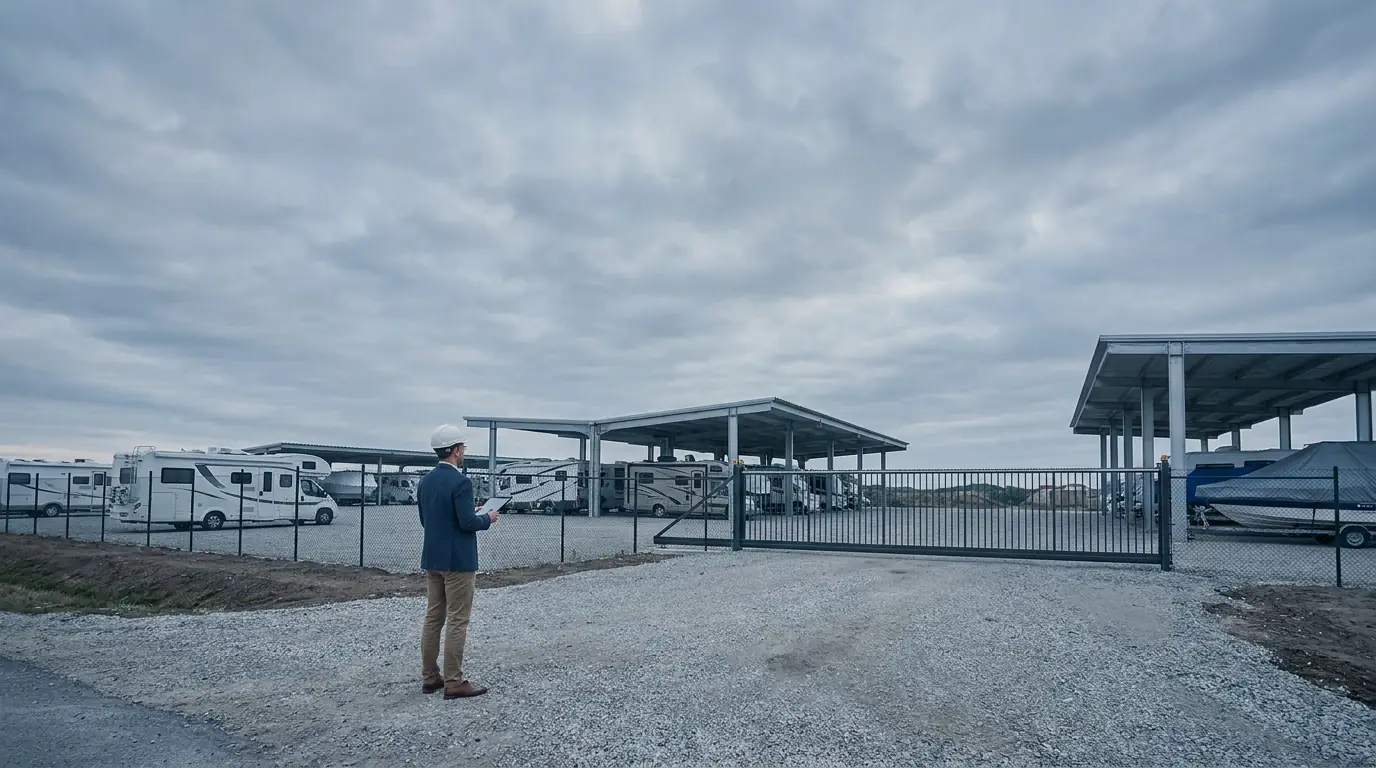
The demand for specialized vehicle storage has surged, driven by growing recreational vehicle ownership and increasingly restrictive housing regulations. For developers and investors, a boat and RV storage facility presents a compelling opportunity, but success hinges on a thorough understanding of market dynamics and financial viability. At SimpleFeasibility, our editorial team, with deep roots in corporate finance and venture investment, provides this E-E-A-T-strong guide to conducting a robust boat and RV storage feasibility study, ensuring your investment decisions are grounded in accurate, current (2026) data and expert analysis.
Understanding Local Demand Drivers for Vehicle Storage
The first step in any comprehensive vehicle storage feasibility study is to meticulously analyze local demand. This involves understanding who owns boats and RVs in your target market and what drives their need for off-site storage.
Boat and RV Ownership Demographics
- RV Ownership Growth: The RV Industry Association (RVIA) reports sustained growth in RV shipments, fueled by younger demographics embracing outdoor lifestyles and flexible work arrangements. Look for areas with a high concentration of retirees, families, and remote workers.
- Boat Ownership Trends: Proximity to lakes, rivers, and coastal areas is paramount. Analyze local boat registrations, marina capacities, and recreational boating activity. High disposable income levels often correlate with increased boat ownership.
- Population Density and Growth: Densely populated urban and suburban areas often create a bottleneck for large vehicle storage, as homeowners lack space. Growing populations, particularly in retirement-friendly states, indicate expanding demand.
Local Regulations and Restrictions
This is a critical, often overlooked, demand driver. Many municipalities and Homeowners' Associations (HOAs) have strict covenants prohibiting or limiting the parking of boats, RVs, and commercial vehicles on residential properties or public streets.
- HOA Restrictions: Research common HOA rules in your target market. A high prevalence of HOAs with vehicle parking restrictions is a strong indicator of unmet demand for off-site storage.
- Municipal Ordinances: Investigate local zoning and parking laws. Some cities restrict the length of time vehicles can be parked on streets or in driveways, or prohibit them entirely.
Competitive Landscape Analysis
Identify existing boat and RV storage facilities within a 5-10 mile radius. Analyze their:
- Pricing: What do competitors charge for open, covered, and enclosed spaces? (More on this later).
- Occupancy Rates: High occupancy rates (85%+) suggest strong demand and potential for new supply.
- Amenities: Do they offer wash stations, dump stations, security features, or 24/7 access?
- Condition and Age: Older, less secure facilities may indicate an opportunity for a modern, premium offering.
Site Selection and Acreage Requirements
The success of your boat and RV storage facility is heavily dependent on location. Strategic site selection can minimize operational challenges and maximize profitability.
Key Site Selection Criteria
- Zoning: Confirm the property is zoned for commercial storage or can be rezoned. Industrial (I), Commercial (C), or even certain Agricultural (A) zones may be suitable, but always verify local codes.
- Accessibility: The site must be easily accessible from major highways or arterial roads, with wide ingress/egress points to accommodate large vehicles. Avoid routes with low bridges or tight turns.
- Visibility: While not as crucial as for retail, good visibility from a main road can aid marketing.
- Utilities: Access to electricity, water, and sewer is essential for security, lighting, office facilities, and potential wash/dump stations.
- Environmental Considerations: Avoid floodplains, wetlands, or areas with unstable soil that could significantly increase development costs or pose long-term risks. A Phase I Environmental Site Assessment is crucial.
Acreage Requirements
The necessary acreage depends on the desired storage mix and scale. As a general rule:
- Small-Scale (Boutique): 2-3 acres might accommodate 75-150 open/covered spaces.
- Medium-Scale: 4-7 acres could support 150-300 units with a mix of types.
- Large-Scale: 8-15+ acres allows for 300+ units, comprehensive amenities, and future expansion.
Factor in space for wide drive aisles (typically 40-60 feet), office/restroom facilities, security buffer zones, and stormwater management.
Storage Type Mix and Capital Expenditure (CAPEX) Tiers (2026)
A crucial aspect of your boat and RV storage business plan is determining the optimal mix of storage types. Each type carries different construction costs and commands varying rental rates.
Storage Type Options and 2026 CAPEX Ranges
These figures are estimates for 2026, assuming moderate inflation and current material/labor costs. They exclude land acquisition but include site work, paving, security, and specific structure costs.
| Storage Type | Description | Estimated 2026 CAPEX per SF | Estimated 2026 CAPEX per Unit (Avg. 12x40 ft) |
|---|---|---|---|
| Open Parking | Gravel or asphalt pad, fenced perimeter, lighting, gate access. | $1.50 - $3.00 | $720 - $1,440 |
| Covered Canopy | Steel or aluminum frame, roof structure, concrete or asphalt pad, lighting. Offers protection from sun/hail. | $15.00 - $25.00 | $7,200 - $12,000 |
| Enclosed Unit | Fully enclosed, individually secured garage-style units (e.g., 12x30, 12x40, 14x50 ft), concrete slab, roll-up doors, lighting, power outlets. | $40.00 - $65.00 | $19,200 - $31,200 (for 12x40) |
Ancillary CAPEX Considerations
- Office/Restroom Building: $150,000 - $300,000 (depending on size and finish).
- Security System: High-definition cameras, access control gates, intercoms. $25,000 - $75,000+.
- Fencing & Gates: Commercial-grade fencing, automated gates. $15 - $30 per linear foot.
- Paving: Asphalt or concrete. $3 - $7 per SF for asphalt, $5 - $10 per SF for concrete.
- Stormwater Management: Retention ponds, drainage systems. Variable, but can be significant.
- Landscaping & Signage: $10,000 - $50,000+.
- Wash/Dump Station: $20,000 - $50,000 (if offered).
- Contingency: Always budget 10-15% for unforeseen costs.
The ideal mix depends on your market's demand and willingness to pay. Enclosed units offer the highest revenue per square foot but also the highest CAPEX. Covered spaces offer a good balance, while open parking provides an entry-level option.
Pricing, Revenue Model, and Lease-Up Strategy
Establishing competitive pricing and a realistic lease-up schedule is vital for accurate financial projections.
Pricing Strategy
Conduct thorough market research to understand local pricing. Consider:
- Per Linear Foot vs. Fixed Size: Many facilities price by unit size (e.g., 12x30, 12x40) or by linear foot for open/covered spaces (e.g., $X per foot for a 30-foot RV).
- Premium for Features: Charge more for covered, enclosed, extra-wide, or pull-through spaces. Amenities like power outlets or individual lighting also command higher rates.
- Seasonal Adjustments: In some markets, demand (and thus pricing) may fluctuate seasonally.
- Incentives: Offer discounts for long-term leases (e.g., 6 or 12 months paid upfront).
Example 2026 Rental Rates (Highly Variable by Market):
- Open Parking: $60 - $120 per month (for a 30-40 ft vehicle).
- Covered Canopy: $120 - $250 per month (for a 30-40 ft vehicle).
- Enclosed Unit (12x40 ft): $250 - $450 per month.
Revenue Model
Beyond monthly rent, consider ancillary revenue streams:
- Late Fees: Standard for storage facilities.
- Administrative Fees: One-time setup fees.
- Retail Sales: RV/boat covers, batteries, cleaning supplies, hitches.
- Wash/Dump Stations: Charge per use.
- Propane Sales: Convenient for RV owners.
- Security Deposits: Standard practice.
Lease-Up and Stabilized Occupancy
A new facility rarely opens at 100% occupancy. A realistic lease-up schedule is critical for cash flow projections.
- Year 1: 30-45% occupancy (initial marketing, building reputation).
- Year 2: 55-70% occupancy (word-of-mouth, repeat customers).
- Year 3: 75-85% occupancy (approaching stabilization).
- Year 4-5: 85-95% stabilized occupancy (depends on market demand and management).
Achieving stabilized occupancy typically takes 3-5 years. Factor in marketing expenses during the lease-up phase.
Financial Analysis: Breakeven, NPV, IRR, and Payback
This is where the rubber meets the road. A robust financial model is the core of any boat and RV storage feasibility study, demonstrating profitability and investment attractiveness.
Key Financial Metrics Defined
- Breakeven Occupancy: The percentage of units that must be rented to cover all operating expenses and debt service.
- Net Present Value (NPV): The difference between the present value of cash inflows and the present value of cash outflows over a period of time. A positive NPV indicates a profitable project.
- Internal Rate of Return (IRR): The discount rate that makes the NPV of all cash flows from a particular project equal to zero. It's the effective annual compound return on the investment. Generally, a higher IRR is preferred.
- Payback Period: The time it takes for an investment to generate enough cash flow to cover its initial cost.
Worked Example: Hypothetical 5-Acre Boat and RV Storage Facility (2026 Projections)
Let's assume a 5-acre site with the following mix and costs:
- Land Cost: $500,000
- Development Mix & CAPEX:
- 100 Open Parking Spaces (12x40 ft): $1,200/space = $120,000
- 50 Covered Canopy Spaces (12x40 ft): $9,000/space = $450,000
- 20 Enclosed Units (12x40 ft): $25,000/unit = $500,000
- Office/Security/Utilities/Paving/Contingency: $600,000
- Total Initial Investment (CAPEX + Land): $500,000 + $120,000 + $450,000 + $500,000 + $600,000 = $2,170,000
Revenue Assumptions (Avg. Monthly Rent per Unit):
- Open: $90
- Covered: $180
- Enclosed: $350
- Total Units: 170
Operating Expenses (Annual):
- Property Taxes: $25,000
- Insurance: $15,000
- Utilities (electricity, water, internet): $10,000
- Management/Marketing: $40,000
- Repairs & Maintenance: $8,000
- Contingency/Other: $5,000
- Total Annual Operating Expenses: $103,000
Lease-Up Schedule & Revenue Projection:
| Year | Occupancy | Open Units Rented | Covered Units Rented | Enclosed Units Rented | Gross Potential Revenue | Less Vacancy | Effective Gross Revenue | Less Operating Expenses | Net Operating Income (NOI) |
|---|---|---|---|---|---|---|---|---|---|
| 1 | 40% | 40 | 20 | 8 | $11,760/month * 12 = $141,120 | 60% | $56,448 | $103,000 | -$46,552 |
| 2 | 65% | 65 | 32 | 13 | $19,110/month * 12 = $229,320 | 35% | $149,058 | $103,000 | $46,058 |
| 3 | 80% | 80 | 40 | 16 | $23,520/month * 12 = $282,240 | 20% | $225,792 | $103,000 | $122,792 |
| 4 | 88% | 88 | 44 | 17 | $25,870/month * 12 = $310,440 | 12% | $273,187 | $103,000 | $170,187 |
| 5 | 92% | 92 | 46 | 18 | $27,040/month * 12 = $324,480 | 8% | $298,522 | $103,000 | $195,522 |
(Note: Revenue assumes average rent and occupancy for simplicity. Real models would have detailed unit-by-unit projections.)
Breakeven Occupancy Calculation
To calculate breakeven, we need to consider both operating expenses and debt service. Let's assume a $1,500,000 loan at 7% interest over 20 years, resulting in an approximate annual debt service of $128,000.
- Total Annual Costs (Operating Expenses + Debt Service): $103,000 + $128,000 = $231,000
- Average Monthly Revenue Per Rented Unit: (($90 * 100) + ($180 * 50) + ($350 * 20)) / 170 = ($9,000 + $9,000 + $7,000) / 170 = $25,000 / 170 = $147.06
- Units Needed to Breakeven: $231,000 / ($147.06 * 12) = $231,000 / $1,764.72 = 130.9 units
- Breakeven Occupancy: 130.9 units / 170 total units = 77%
This means the facility needs to reach 77% occupancy to cover all its costs. Based on our lease-up, this would occur sometime in Year 3 or early Year 4.
NPV, IRR, and Payback Period (Simplified 5-Year Example)
For a full analysis, a 10-20 year projection is typical, including a terminal value calculation (sale of the asset). For this example, we'll use a simplified 5-year cash flow and assume a discount rate of 10%.
- Initial Investment (Year 0): -$2,170,000
- Cash Flow Year 1 (NOI - Debt Service): -$46,552 - $128,000 = -$174,552
- Cash Flow Year 2 (NOI - Debt Service): $46,058 - $128,000 = -$81,942
- Cash Flow Year 3 (NOI - Debt Service): $122,792 - $128,000 = -$5,208
- Cash Flow Year 4 (NOI - Debt Service): $170,187 - $128,000 = $42,187
- Cash Flow Year 5 (NOI - Debt Service): $195,522 - $128,000 = $67,522
Using these cash flows (without terminal value for simplicity, which would significantly impact NPV/IRR for a real project):
- NPV (at 10% discount rate): Calculation based on these cash flows would likely be negative or marginally positive due to the short horizon and no terminal value, indicating the need for a longer-term view and asset appreciation.
- IRR: Similarly, a short horizon impacts IRR. For a real project, IRRs of 12-20%+ are often targeted by investors.
- Payback Period: Based on these cash flows, a simple payback would take well beyond 5 years, again highlighting the need for a longer projection and terminal value.
Real-World Application: A comprehensive SimpleFeasibility study would model 10-20 years, include depreciation, tax implications, and a realistic exit (sale) value to provide a complete picture of NPV and IRR, which are typically robust for well-executed boat and RV storage projects. Consultants charge $3,000-$7,000 and take weeks to deliver this level of analysis; SimpleFeasibility delivers the same analysis in minutes for $200.
Key Risks and Mitigation Strategies
Every investment carries risk. Identifying and planning for potential pitfalls is crucial for a successful boat and RV storage business plan.
- Market Saturation: If too many facilities open in a short period, it can depress rental rates and extend lease-up times. Mitigation: Thorough initial market analysis, monitor competitor developments, differentiate your offering.
- Economic Downturns: Recreational vehicle ownership and storage can be discretionary spending. Mitigation: Maintain strong financial reserves, offer flexible lease terms, focus on operational efficiency.
- Regulatory Changes: Zoning laws, environmental regulations, or building codes can change, impacting operations or future expansion. Mitigation: Engage with local planning departments early, stay informed on legislative changes.
- Interest Rate Fluctuations: Rising interest rates can increase debt service costs. Mitigation: Secure favorable long-term financing, consider fixed-rate loans, maintain a healthy debt-service coverage ratio.
- Insurance Costs: Storing large, valuable vehicles can lead to high insurance premiums. Mitigation: Implement robust security, work with specialized insurance providers.
- Environmental Concerns: Spills, stormwater runoff, or other environmental issues can lead to fines or remediation costs. Mitigation: Implement best management practices, conduct regular environmental audits.
Financing Your Boat and RV Storage Project
Securing the right financing is paramount. Understanding your options and what lenders look for will streamline the process.
SBA Loans
The Small Business Administration (SBA) offers attractive loan programs, particularly for owner-operators.
- SBA 504 Loan: Ideal for real estate and equipment purchases. It offers long terms (up to 25 years for real estate) and low down payments (often 10-15%). It involves a first mortgage from a conventional lender and a second mortgage from a Certified Development Company (CDC).
- SBA 7(a) Loan: More flexible, can be used for real estate, construction, equipment, and working capital. Max loan amount up to $5 million.
SBA loans are often preferred for their favorable terms, but the application process can be rigorous and time-consuming.
Conventional Bank Loans
Commercial real estate loans from traditional banks are another common option. These typically require:
- Higher Down Payments: Often 20-30% of the project cost.
- Strong Sponsor Experience: Lenders prefer borrowers with a track record in real estate development or business operations.
- Robust Feasibility Study: A well-documented boat and RV storage feasibility study proving market demand and financial viability is essential.
What Investors Look For
Whether seeking debt or equity partners, investors prioritize:
- Thorough Market Analysis: Clear evidence of unmet demand and limited competition.
- Realistic Financial Projections: Conservative revenue and expense forecasts, with clear assumptions.
- Experienced Management Team: A team with a track record in real estate, operations, or self-storage.
- Strong Cash Flow: Projects with healthy Net Operating Income (NOI) and Debt Service Coverage Ratios (DSCR).
- Exit Strategy: How will they get their money back? (e.g., sale of the facility, refinancing).
- Risk Mitigation: A clear understanding of potential risks and plans to address them.
Conclusion: Your Path to a Profitable Boat and RV Storage Investment
Developing a boat and RV storage facility can be a highly lucrative venture, offering stable income and strong asset appreciation. However, success is not accidental. It is the direct result of meticulous planning, in-depth market research, and rigorous financial analysis. A comprehensive boat and RV storage feasibility study, delving into local demand, site specifics, CAPEX, pricing, and financial metrics, is the indispensable first step.
As the SimpleFeasibility Editorial Team, we emphasize that while consultants may charge $3,000-$7,000 and take weeks to provide this critical analysis, platforms like SimpleFeasibility empower you to generate a detailed, investor-ready feasibility study in minutes for a fraction of the cost ($200). Arm yourself with data-driven insights and confidently navigate your next investment opportunity.